0. Introduction Why is 20 20 Aluminum Extrusion So Popular
The 20 series aluminum extrusion, particularly the ubiquitous 20mm x 20mm profile, has become the foundational building block for modern, agile manufacturing. This T-slot system underpins everything from custom automation cells and robotics to the rigid aluminum frame parts of high-speed 3D printers. Its popularity stems from its high modularity and ease of assembly.
Yet, this small, versatile profile presents a massive quality challenge.
Any slight deviation in straightness or tolerance can undermine the entire structure. If a single 1-meter length of 20 20 aluminum extrusion is bent by just half a millimeter, the cumulative error in a multi-axis system can render the project useless.
This guide provides the necessary technical insights. It allows you to move beyond basic purchasing to understanding the cold-end manufacturing processes. We will demonstrate why only precision equipment, like that specialized by Pinrui Machinery, can reliably produce the quality of 20 series aluminum extrusion your complex projects demand.
1. Part I Understanding Key Quality Metrics of 20 Series Aluminum Extrusion
While the 20 series aluminum extrusion may appear simple, its successful application depends on meeting three non-negotiable quality standards. These standards are what separate reliable profiles from structural failures.
1.1 Precision Challenge Why Tolerance is Critical for 20 20 Aluminum Extrusion
The core value of T-slot profiles is their system integration capability. This relies entirely on dimensional accuracy.
- Interchangeability Standard: The precision of the T-slot groove width and depth must be tightly controlled. This ensures that essential extruded aluminum hardware—like T-nuts, connectors, and end caps—can be inserted, slide smoothly, and lock securely across every batch of 20 20 aluminum extrusion you use.
- Straightness and Assembly: Imagine assembling a square aluminum frame part 2 meters long. If the profiles are not perfectly straight, the connection points will be under stress, compromising the structural integrity. This lack of straightness is the number one cause of alignment failure in automation and robotics.
- Key Terminology: When sourcing 20 series aluminum extrusion, always request proof that the supplier adheres to stringent dimensional standards, such as those governed by EN and ISO standards for small cross-section profiles, especially concerning twist and camber.
2. Part II Tracing Precision How Cold-End Equipment Impacts 20 Series Performance
The difference between a high-tolerance and a low-tolerance profile is forged not at the die, but in the minutes immediately following the press, known as the cold end. This is where most defects in 20 series aluminum extrusion are introduced.
2.1 Residual Stress How to Damage the Long-Term Stability of 20 20 Aluminum Extrusion
Residual stress is the silent enemy of dimensional stability, particularly in thin-walled profiles like the 20 20 aluminum extrusion. This stress is invisible but lethal to the long-term integrity of the profile.
The uneven cooling during the required quenching treatment is the root cause. When the exterior of the aluminum cools and shrinks faster than the interior, internal forces are locked in. These forces, if not released, will eventually cause the extruded parts to warp, especially after subsequent cutting or machining.
The tension stretching phase is therefore essential. It must perform controlled plastic deformation to fully release this residual stress.
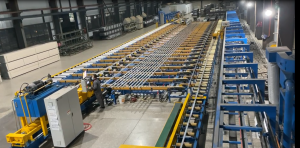
Pinrui utilizes the power of the full-servo puller to address this. This system ensures the profile receives a precise, uniform, and measurable pulling force. This expert technique is the only way to guarantee a zero-stress result for high-precision 20 series aluminum extrusion destined for critical applications.
2.2 Surface Finish The Key to Guaranteeing the Perfect Appearance of Aluminium Extrusion Parts
The surface quality of aluminium extrusion parts directly reflects professionalism and durability. For 20 20 aluminum extrusion, which is often visible as a frame, aesthetics and protective coating integrity are crucial.
- Impact of Scratches on 20×20: Scratches compromise the aesthetic appeal and, more critically, break the oxide layer, making the profile susceptible to corrosion. This is a significant issue for aluminum extrusion accessories used in industrial environments.
- Risks of Manual Handling: Manual stacking is the primary source of surface damage. The high labor cost for manual stacking is often compounded by the cost of rejects and expensive quality control required to mitigate human error and fatigue. This inefficiency creates a persistent Finishing Line bottleneck.
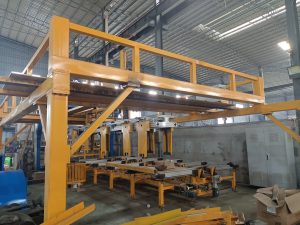
- Automation Solution: To eliminate this, modern manufacturers must invest in automation. Robotic systems offer consistent, gentle handling, protecting the aluminium extrusion parts and maximizing operational throughput.
3. Part III Pinrui’s Precision Manufacturing Solutions Enabling High-Quality 20 Series Aluminum Extrusion Production
Pinrui Machinery specializes in engineered solutions that solve the industry’s most persistent cold-end problems. Our technology translates directly into superior quality for every 20 series aluminum extrusion profile.
3.1 Servo Puller How to Guarantee the Straightness of 20 20 Aluminum Extrusion
The transition from hydraulic to servo technology is the biggest leap in cold-end precision.
Our full-servo puller systems provide closed-loop control over the stretching process. This eliminates the pressure fluctuations common in older systems, ensuring that even the most delicate 20 20 aluminum extrusion profiles maintain perfect straightness and dimensional consistency.
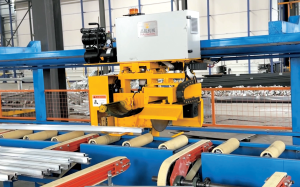
For high-volume operations, the alternating full servo puller ensures continuous traction. This is vital for maximizing press uptime and maintaining high throughput without sacrificing the dimensional stability required for long extruded aluminum strut components. Our technical heritage, evidenced by 24 patents, guarantees this level of process control.
Whether you require a dedicated, high-precision single puller or a twin-head system like the twin head double saw puller for complex profiles, Pinrui offers customized solutions designed for your specific 20 series product portfolio.
3.2 Automated Stacking How to Achieve Cost-Effectiveness in 20 Series Production
Automation is the non-negotiable path to cost efficiency and quality assurance in modern 20 series aluminum extrusion manufacturing.
Ending Labor Cost: Deploying an automatic stacker immediately ends the reliance on the high labor cost for manual stacking. This investment has a rapid robot stacking system ROI, often achieved within 1.5 to 3 years in multi-shift operations. Furthermore, it eliminates the unpredictable quality risks associated with human fatigue.
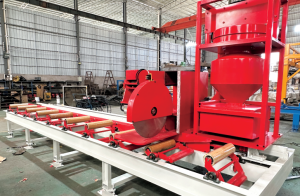
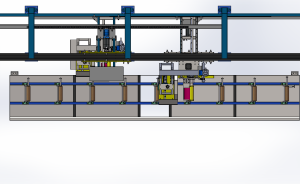
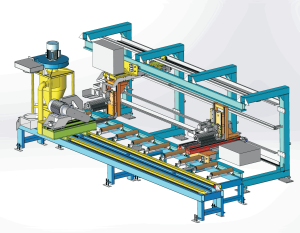
Full-Process Integration: Pinrui’s expertise lies in providing fully automated finishing line integration. This comprehensive approach synchronizes every step, from the automatic handingtable production line and the finish saw and saw gauge system machine all the way to the automatic stacker. This integration eliminates buffer times and bottlenecks.
Our global experience, operating in over 30 export countries, confirms that integrated automation is the most sustainable way to produce high-volume, defect-free aluminium extrusion parts.
4. Part IV Buyer’s Guide A Deep Dive Perspective for 20 Series Aluminum Extrusion Users
If you purchase 20 series aluminum extrusion in bulk, your structural reliability depends on your supplier’s manufacturing process. Use these three questions to vet your potential providers.
4.1 Evaluating 20 20 Aluminum Extrusion Suppliers Three Hidden Questions
These questions move beyond surface-level quotes and target the supplier’s commitment to quality control technology.
Question 1: Do you use servo-driven stretching equipment?
- Why it matters: Suppliers still using old hydraulic pullers are likely introducing residual stress into their extrusion parts. Servo systems guarantee the zero-stress state vital for demanding applications. Look for evidence of a full-servo puller or similar precision systems.
Question 2: What is the automation level of your stacking line?
- Why it matters: A manual stacking area indicates a risk of surface defects (scratches, dents) and a lower throughput capacity. Fully automated lines, featuring the automatic stacker, guarantee both superior surface quality and a more stable supply chain for aluminum extrusion accessories.
Question 3: How do you ensure the uniformity of your quenching treatment?
- Why it matters: Uniform cooling is essential for aluminium hardening and achieving the required mechanical properties. Ask if they use specialized technology like online quenching with integrated control systems to ensure consistent hardness across the entire length of the extruded aluminum strut.
5. Part V FAQs and Future Trends Q&A and Outlook for 20 20 Aluminum Extrusion
The versatility of the 20 series aluminum extrusion ensures its continued relevance. Here are answers to common technical queries and a glance at what’s next.
5.1 Common Technical Questions and Answers for 20 20 Aluminum Extrusion
Q1: What is the max load-bearing capacity of 20×20?
The maximum load is highly dependent on the alloy (e.g., 6061 vs 6063), the support span, and the specific application (compression vs. bending). Always request the supplier’s Moment of Inertia (I-value) for their specific profile to calculate load scientifically.
Q2: How to distinguish high-precision extruded aluminum strut and low-precision products?
Beyond using a caliper to check the T-slot width, inspect the cutting surface. A high-quality profile cut by a precise finish saw and saw gauge system machine will have minimal burrs. Also, try assembling the profile with various connectors—high-precision extrusion parts will fit snugly and require minimal effort.
Q3: How will the 20 Series evolve in the future?
The future of 20 20 aluminum extrusion lies in intelligent integration. We anticipate a rise in profiles designed for IIoT (Industrial Internet of Things) smart frames, incorporating integrated channels for embedded wiring and sensors, further driven by the reliability of advanced manufacturing equipment.
Conclusion Investing in Precision is Investing in the Future of 20 Series
The difference between a failing aluminum frame part and a reliable industrial structure often comes down to the precision of the finishing line equipment. Producing high-quality 20 series aluminum extrusion efficiently requires eliminating the variables introduced by manual labor and inconsistent machinery.
Pinrui Machinery is dedicated to ensuring your products—and your projects—succeed. By investing in our patented technology, such as the full-servo puller and integrated automation systems, manufacturers can eliminate residual stress and overcome the Finishing Line bottleneck. This guarantees consistent quality and provides a significant robot stacking system ROI.
Ready to transform your operation and elevate your 20 series aluminum extrusion quality to a globally recognized standard? Pinrui provides the technical expertise and proven solutions—backed by 24 patents and trusted across 30 export countries.
Contact us today for a consultation, or visit our homepage to explore our technology.