Heat treatment is the heart of metal manufacturing. Among all cooling methods, water remains the most powerful and widely used medium in the industry. Whether you are dealing with high-volume aluminum extrusions or heavy-duty steel components, your choice of cooling strategy determines the final mechanical properties of your product.
Quenching might seem like a simple process of dunking a hot metal part into a tank of cold liquid. However, for engineers and plant managers, it is a delicate balance of physics, metallurgy, and equipment precision. This guide explores the depths of water quenching to help you optimize your production line for maximum hardness and minimal distortion.
Is Your Part Ready for Water? Understanding the Admission Criteria
The first step in any thermal processing cycle is deciding if your material can handle the thermal shock. Water provides the most severe cooling rate available in commercial heat treating. This severity is both a blessing and a risk.
When we discuss water quenching steel, we are usually looking at low-carbon alloys. If the carbon content exceeds 0.35 percent, the internal stresses caused by the rapid formation of martensite can lead to catastrophic cracking. High-carbon steels often require a more tempered approach, such as oil or polymer quenching, to avoid becoming too brittle.
In the world of water and aluminum, the challenges shift toward geometry and alloy chemistry. Aluminum alloys in the 2xxx, 6xxx, and 7xxx series rely on quenching to keep alloying elements in a solid solution. However, if your aluminum profile has thin walls next to thick sections, the thick parts will stay hot while the thin walls contract instantly. This imbalance creates warping. You must evaluate the structure of your part before choosing water. A simple rule of thumb is to look for section thickness ratios exceeding three to one. If your part falls into this high-risk category, you need advanced spray control or a different medium.
The Performance Window: Why Temperature Control is Non-Negotiable
A common mistake in many factories is assuming that as long as the water is liquid, it is doing its job. In reality, water quenching is highly sensitive to the initial temperature of the medium.
To achieve the desired T6 temper in aluminum, you must navigate the critical cooling window. This window usually sits between 400 degrees Celsius and 290 degrees Celsius. In this range, the cooling must be fast enough to prevent the solute from precipitating at the grain boundaries. If the water in your tank is too warm, the cooling rate drops exponentially.
Industrial data shows that water at 20 degrees Celsius provides a much higher cooling capacity than water at 60 degrees Celsius. Once the water temperature crosses the 60-degree threshold, the cooling rate is often too slow to maintain the solid solution. This results in soft parts that fail hardness tests. Consistency is the key to quality. You cannot have the first batch of the day cooling at 20 degrees and the last batch at 50 degrees.
For more details on managing these material transitions, you can explore the differences between steel and aluminum quenching to better understand how each metal reacts to thermal gradients.
Breaking the Vapor Barrier: The Physics of the Quench
What happens the moment you quench in water? The physics of the process involve three distinct stages. Understanding these stages is the only way to troubleshoot quality issues like “soft spots.”
The first stage is the vapor blanket stage. When a red-hot part hits the water, a layer of steam instantly surrounds it. This steam acts as an insulator. It actually slows down the cooling process. If this blanket stays attached to the part for too long, the metal underneath will not harden correctly.
The second stage is nucleate boiling. This is the most efficient cooling phase where the vapor blanket collapses and the water boils violently against the metal surface. Finally, the third stage is the convective cooling phase, where the metal temperature drops below the boiling point of water.
The goal of a professional water quench system is to break the vapor blanket as quickly as possible. This is achieved through agitation. By using powerful pumps or propellers, you can physically tear the steam away from the metal. Without proper agitation, the vapor blanket can get trapped in pockets or holes, leading to uneven hardness and high residual stress.
Achieving precision online quenching control is the only way to ensure that every square inch of your profile receives the same cooling intensity.
Beyond the Tank: When to Consider PAG and Other Alternatives
While quenching with water is cost-effective and environmentally friendly, it is not always the best engineering choice for high-precision parts. Many modern facilities are moving toward polymer quenchants, such as Polyalkylene Glycol (PAG).
Think of PAG as a “customizable” version of water. By adjusting the concentration of the polymer in the water, you can mimic the cooling curve of oil while maintaining the safety of a water-based system. When you use a polymer, it forms a thin film on the metal surface during the initial quench. This film slows down the cooling just enough to reduce the risk of warping while still being fast enough to achieve high hardness.
This is particularly useful for aerospace components or complex automotive extrusions. Choosing between pure water and a polymer solution is a matter of calculating your Total Cost of Ownership. While polymer is more expensive upfront, it can save thousands of dollars in secondary straightening and rework costs. You can learn more about different quenching treatments to see which medium fits your specific alloy and production volume.
Building the Foundation: Modern Equipment and Maintenance
A world-class quenching process requires more than just a tank and some water. It requires an integrated system designed for long-term stability. At Pinrui Machinery, we have spent years refining the hardware that supports these thermal cycles. Our 24 patents and exports to over 30 countries are a testament to our focus on system reliability.
A modern water quenching station must solve three engineering problems. First, it must manage heat. You need a robust plate heat exchanger and a cooling tower to keep your water temperature within a five-degree variance. Second, it must manage cleanliness. Aluminum scales and oxides can clog nozzles and wear out pumps. A multi-stage filtration system is essential.
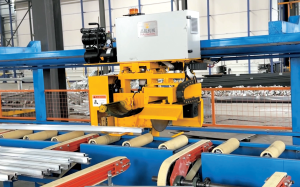
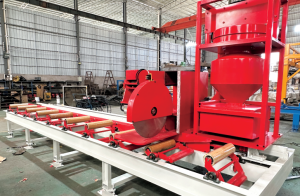
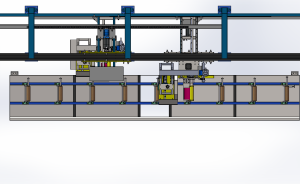
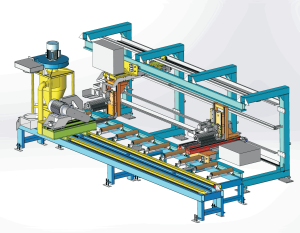
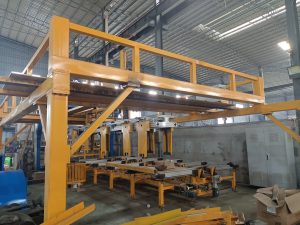
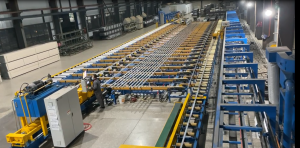
Third, the system must be integrated into the wider production flow. For example, our translational type cooling bed production lines are designed to move extrusions directly from the press into a controlled water curtain or spray zone. This automation reduces human error and ensures that the time between the press and the quench is minimized.
Proper maintenance is also vital. You should implement a weekly check of the water pH levels and nozzle integrity. Hard water can cause mineral buildup in your sprayers. This leads to uneven cooling and, eventually, part failure.
Frequently Asked Questions (FAQ)
1. Why does my aluminum warp every time I use water quenching?
Warping is usually caused by uneven cooling. If one side of your profile is hit by water before the other, or if the vapor blanket is not broken evenly, the resulting internal stresses will bend the metal. Improving your agitation or nozzle layout is the best fix.
2. Can I use tap water for my quenching tank?
You can, but it is not recommended for high-precision work. Tap water contains minerals that can lead to scale buildup on your parts and in your cooling system. Distilled or treated water is better for long-term equipment health.
3. What is the standard warranty for Pinrui quenching equipment?
We offer a comprehensive warranty and after-sales support package. For specific details regarding your custom machine configuration, please contact our engineering team directly through our contact page.
Conclusion: Engineering Your Success
Water quenching is a powerful tool in the hands of a knowledgeable engineer. By understanding the metallurgy of the performance window and the physics of the vapor blanket, you can turn a risky process into a competitive advantage.
Whether you are looking to upgrade an existing line or build a new high-speed extrusion facility, the equipment you choose is the backbone of your quality. At Pinrui Machinery, we specialize in creating custom solutions that bridge the gap between academic theory and factory floor reality.
Are you ready to optimize your quenching process and reduce your scrap rates? Contact our expert team today for a free consultation and let us help you design a system that delivers consistent results every single shift.